Crossbow Bolts vs. Modern Armor: A Super-Spike Threat That Standards Don’t Address
A low-cost hunting crossbow, which you can buy almost anywhere without a license, fires a 390-grain crossbow bolt at 405 feet per second, delivering approximately 190 joules of impact energy – nearly three times the highest spike protection rating in either the NIJ or VPAM standards.
The scale goes like this:
NIJ Spike 1: 36 J
NIJ Spike 2: 50 J
NIJ Spike 3: 65 J
VPAM Spike 4: 80 J
Crossbow (390 gr @ 405 fps): ~190 J
There are 14–15 joules of impact energy separating each level. This means that if the NIJ scale were extrapolated linearly, 190 joules would correspond to approximately “Spike 12+” – more than nine levels beyond the top of a scale that stops at three.
190 J isn’t much energy in comparison with what bullets deliver. Take what might be the most common street handgun threat, the 115gr. 9mm FMJ. That bullet, fired from a handgun, will hit with around 481 joules of impact energy, but there’s a catch: kinetic energy density, or the energy a threat delivers in relation to the threat’s area.
Gotts (2015) reported kinetic energy density values for standard ammunition types. Under Gotts’ framework, 124gr. 9mm FMJ at 1305 fps loads armor at approximately 2.8 J/mm² and 7.62×51mm M80 at 2780 fps at 18.8 J/mm². [1] (These numbers reflect each projectile’s effective engagement area; the bullet’s loading footprint including deformation effects.)
A crossbow bolt, however, does not deform on impact. Its hardened steel tip maintains its geometry throughout the penetration event – a fact confirmed by ISL, who observed that bolt tip contact surfaces remained “hardened and raised” after perforating body armor. [2] This means the bolt’s effective engagement area is simply its tip area: approximately 3 mm² for a standard field point.
At 190 J over ~3 mm², the bolt’s kinetic energy density is approximately 63 J/mm² – more than 20× the 9mm FMJ and more than 3× the 7.62mm rifle ball under the Gotts framework.
This is not a game played with arithmetic. A deforming bullet spreads its energy across a wide fiber engagement cone. A rigid, non-deforming penetrator concentrates it on a point. Textile-based and fiber-composite armor were optimized for the former, not the latter.
Comparative table, largely from Gotts:
|
Threat |
Velocity |
KE (J) |
Effective Engagement Area (mm2) |
KE Density (J/mm2) |
|
9×19mm FMJ (NIJ HG1) |
398 m/s |
713 |
254 |
2.8 |
|
.357 SIG (NIJ IIIA) |
448 m/s |
813 |
259 |
3.1 |
|
7.62×51mm M80 (NIJ III) |
847 m/s |
3,444 |
183 |
18.8 |
|
FN P90 5.7×28mm |
715 m/s |
540 |
102 |
5.3 |
|
H&K MP7 4.6×30mm |
725 m/s |
420 |
66 |
6.3 |
|
Crossbow bolt (field point, tip) |
123 m/s |
190 |
~3–5 |
~40–65 |
In other words, the crossbow bolt, despite carrying a fraction of the kinetic energy of a 9mm round, presents a kinetic energy density at its tip that is an order of magnitude higher than any handgun round – and several times higher than even the 7.62mm M80 rifle ball. It is, in energy density terms, off the scale.
Even at the NIJ Spike 1 overtest energy of 36 J, the same tip geometry produces roughly 12 J/mm2, which is 4.3 times more than our high-velocity 9mm bullet. This happens to be why a lot of soft armor panels that are rated to stop 9mm FMJ aren’t rated to stop spikes at the lowly Spike 1 energy level.
So, when we say that the NovaSteel Breastplate offers “spike and knife protection beyond spike/knife-3,” what better way to test that than against a crossbow bolt? And, to broaden the experiment, why not bring in conventional riot armor, an ACH helmet, and a NovaSteel helmet?
Testing Crossbows vs. Armor
A video is forthcoming. For now suffice it to say that the NovaSteel Breastplate stopped the crossbow bolt (and destroyed the bolt) whereas the riot armor was penetrated with ease.
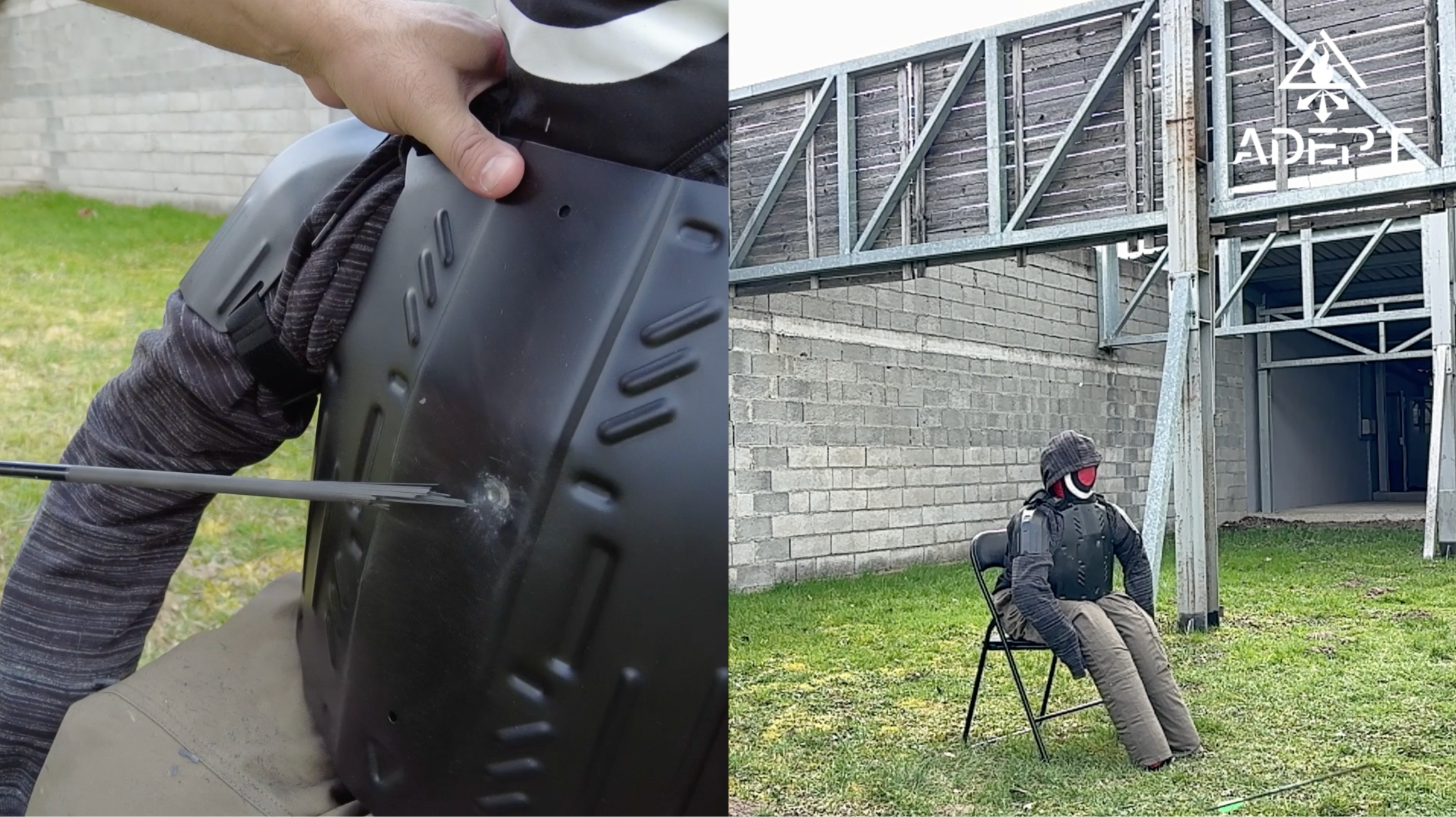
What’s even more interesting is what happened to the helmets.
As with the Breastplate, the NovaSteel helmet stopped the bolt cleanly, destroying it on contact. It didn’t even leave much of a dent.
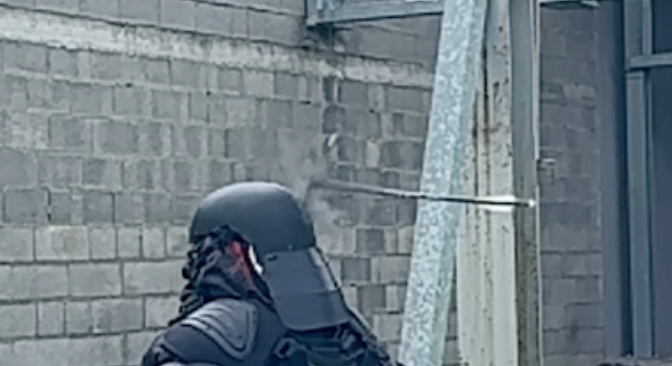
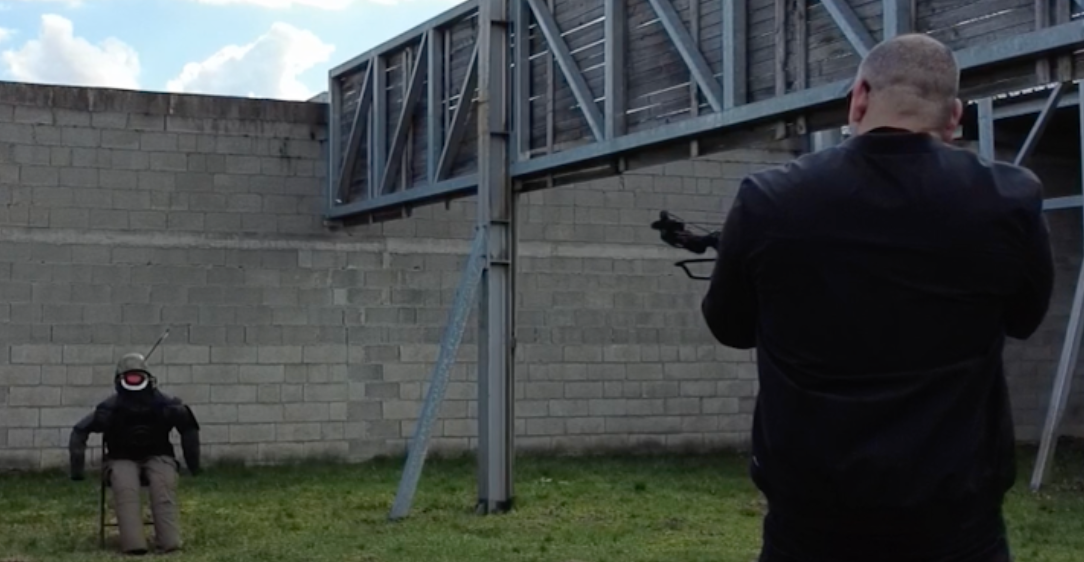
Yet the ACH failed completely against both field point and broadhead tips. Versus the field point, there was six inches of penetration.
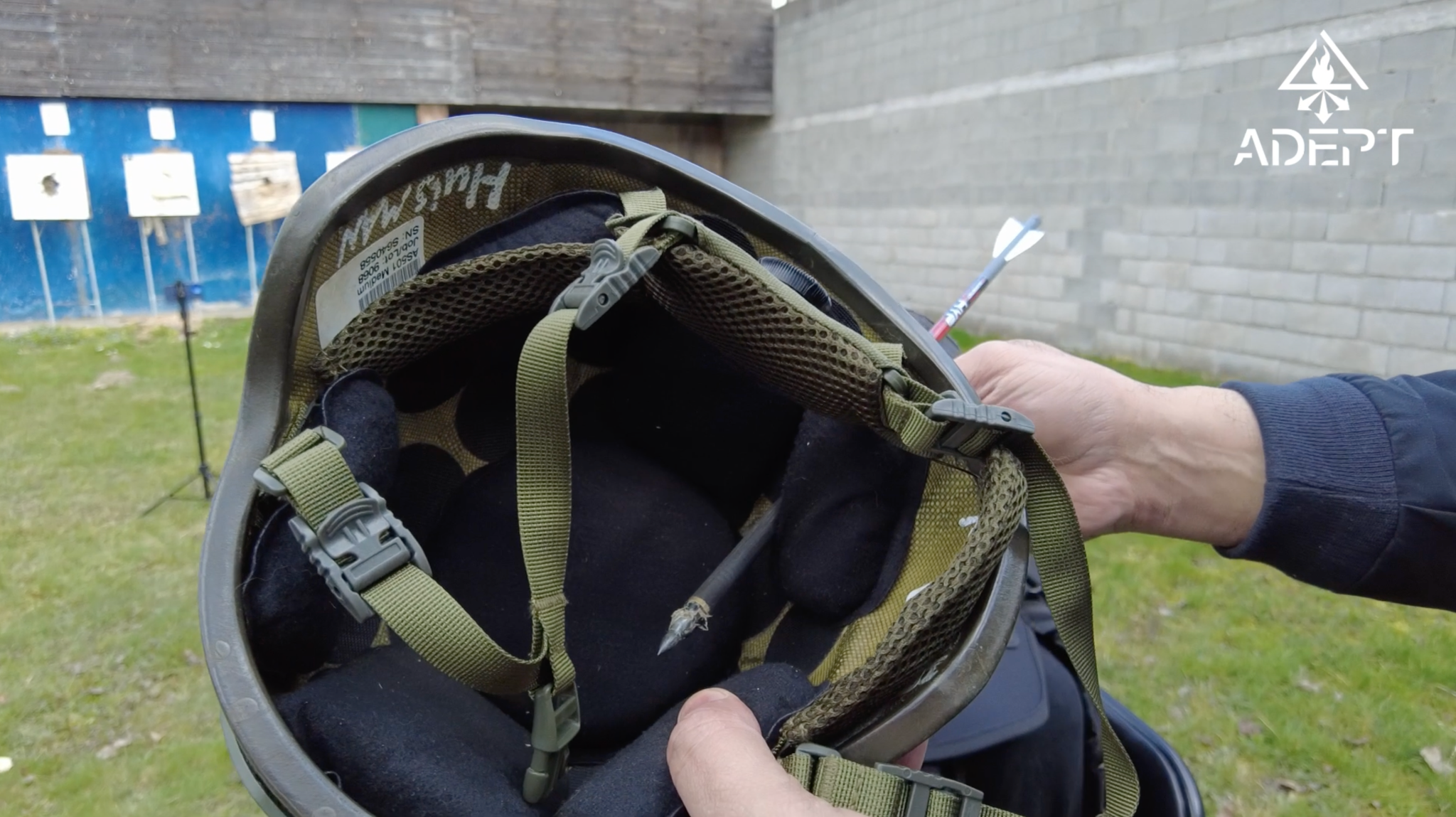
It may be illustrative to consider why this is the case. Woven aramid fibers – Kevlar, Twaron, and similar para-aramids – absorb ballistic energy through tensile strain. When a projectile strikes the weave, it engages a number of fibers simultaneously. Those fibers, which have very high tensile strengths, stretch, transmitting the load outward in a cone-shaped wave. The larger the projectile’s cross-section, the more fibers it engages, and the more effectively the weave distributes and absorbs the energy. This is why handgun bullets, which present a relatively large frontal area (and usually expand upon impact), are well-suited to being caught by aramid. The same applies to fragments and shrapnel, which tend to have irregular shapes that engage many fibers at once.
This, by extension, easily explains why AP bullets are made of hard and non-deforming materials in sharp conical geometries: AP bullets present a much higher kinetic energy density which, by design, is sustained throughout the penetration process.
As with AP rounds, so too with our crossbow bolt. And this is the fundamental reason that a helmet rated to stop 9mm FMJ at 1400+ fps is defeated by a crossbow bolt at 405 fps. The aramid fibers never have the opportunity to engage the projectile and absorb its energy through tensile strain. The bolt tip is narrower than the weave spacing. It slips between or cuts the fibers, and the full energy of the shaft is delivered behind the armor.
Bolts and Bullets vs. Rigid Metal
Yet, as we’ve seen, the bolt is easily defeated by a thin metal shell. If its energy density is so high, the question becomes: How does a sheet of metal alloy succeed where that aramid helmet failed?
Put it like this: Sufficiently hard metals are more sensitive to overall kinetic energy loading, and much less sensitive to kinetic energy density.
In metal, perforation is not governed by tip loading alone. The target must be forced to yield, stretch, crack, plug, or petal over a much larger volume, and the penetrator must remain structurally intact while doing so. That favors projectiles with much greater total energy and momentum. A .44 Magnum has far lower kinetic energy density than the bolt, but roughly 7.8 times the total energy and more than twice the momentum. Once the steel denies the bolt an easy puncture path, the bolt’s long, slender shaft becomes a liability: The point stalls, the load reflects into the shaft as compressive and tensile stress, and the bolt breaks. The .44 Magnum, by contrast, remains a compact mass and continues to drive plastic deformation of the metal. In short, the bolt is a puncture-optimized threat; the .44 Magnum is a plate-work threat.
When there are fibers to split, a weave to bypass, and a tensile absorption mechanism to circumvent, a rigid body with a high kinetic energy density is the ideal penetrator. It can push aside yarns and tunnel through. When, instead, armor is designed for energy dissipation through bulk hardness and structural rigidity, the best counter is to dump lots of kinetic energy into it. Make no mistake, geometry helps – a long rod will always penetrate metallic armor better than a sphere, a cubic fragment, or a flat coin – but energy dominates.
Why the Crossbow Is a Harder Test Than a Knife
It is tempting to view the crossbow test as a more exotic version of a standard spike or knife test. It is, however, a significantly harder test – and for reasons that go beyond the raw energy numbers.
NIJ spike and knife tests are conducted at 36-65 joules, using standardized spike and blade geometries dropped from a known height. The test spike is an engineered penetrator designed for repeatability. At these energy levels, the interaction between the spike and the armor is well-characterized. But there is an important limit to the spike test that is rarely discussed: The spike itself is exceptionally long, narrow, and structurally weak. The knives are small and narrow. At higher energies, steel spikes and knife blades begin to deform, bend, or shatter on impact. The weapon itself becomes the limiting factor.
In other words, a hand-driven knife thrust, even a very powerful one, delivers perhaps 30-100 joules – which is more or less within the NIJ/VPAM test envelope. But scaling that energy upward by driving the same blade harder doesn’t produce a proportionally harder test, because the blades are inherently structurally limited, and they will bend or break before the armor does.
The thin cross-section of the test knife blade makes it a self-limiting penetrator, and the spike, which is soft as well as narrow, is still more limited.
We’ve tested a lot of stab-rated armor at Adept, and we’ve seen it time and time again: At 36J, NIJ test knives and spikes that don’t penetrate take a bend. At significantly higher energies, the knives break, and the spikes curl up into wacky spirals.
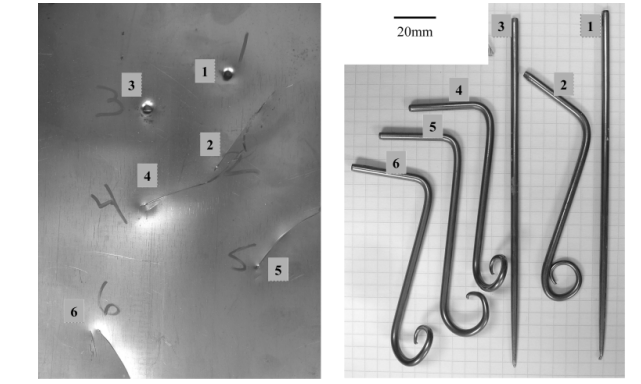
(Spike testing a titanium sheet at between 113 – 158 J. From: Fanning, J.C. Military applications for β titanium alloys. J. of Materi Eng and Perform 14, 686–690 (2005). https://doi.org/10.1361/105994905X75457)
A crossbow bolt does not have this limitation. The bolt is a thick-walled carbon fiber tube with a hardened steel tip, backed by significant mass (25-28 grams) and arriving at ~400 fps. The tip is supported by the shaft’s rigidity and mass, and maintains its geometry throughout the penetration event. It does not bend, buckle, or lose its shape on impact. What would happen first is that the shaft breaks – but it takes a lot of reflected compressive and tensile energy for that to happen, and it only happens when the bolt comes into contact with a very rigid body.
So not only is the crossbow test tougher than any current knife/spike test standard, it’s tougher than any knife/spike test standard can possibly be, unless and until new test knife and spike geometries are designed. It is, in many respects, a worst-case scenario for fiber-based armor.