Armor Plate Sizes Explained: Finding the Perfect Fit
How to Measure
The two distances that matter for plate sizing. Both start at the suprasternale — the jugular notch at the top of your sternum.
D27
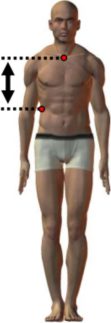
Jugular Notch to 10th Rib
The vertical distance from the dip at the top of your sternum to the bottom edge of your rib cage. This is the full rib-cage envelope — your coverage target.
Male 50th percentile: 31.8 cm
Female 50th percentile: 27.3 cm
D28
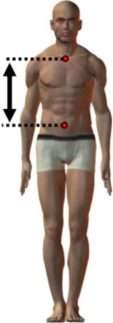
Jugular Notch to Navel
The vertical distance from the jugular notch straight down to your belly button. This is your mobility ceiling — plates should not extend past this point.
Male 50th percentile: 38.1 cm
Male 95th percentile: 42.7 cm
I’ll get right to the point: for the majority of adult men, the correct answer is Medium SAPI or 10×12″ — and the rigorous reason is that front-plate sizing is constrained mainly by torso height, not torso width.
There is a persistent myth in the armor world that plate sizing is about how big you are. Broad shoulders, big chest, size up. It sounds intuitive. It is also wrong.
The real constraint on front-plate sizing is torso height — specifically, the vertical distance your rib cage gives a plate to work with. Width matters too, but it matters in a different way than most people think, and it almost never determines your size. Once you understand the anatomy and the vulnerability data, a lot of bad sizing advice falls apart very quickly.
Not All Coverage Is Equal
Before we get to the anthropometry, we need to answer a question most plate-sizing discussions skip entirely: what, exactly, are you trying to cover?
The naive answer is “the rib cage.” But the rib cage is not a uniform target. Lethality is not evenly distributed across the thorax. The structures that produce rapid incapacitation or death from penetrating trauma — the heart, the aortic arch, the great vessels, the central pulmonary vasculature — are concentrated in the upper and central thorax, well above the bottom of the rib cage.
This means plate coverage is not a binary pass/fail. It is a continuous tradeoff with diminishing marginal returns, weighted heavily toward the top of the plate. That insight is the foundation of the framework the sizing engine uses, which breaks the thorax into three vertical zones:
Zone 1 — Minimum Vital Coverage. Heart, aortic arch, great vessels, central pulmonary structures. The non-negotiable zone. A plate that fails to cover this region fully is not doing its primary job.
Zone 2 — Extended Vital Coverage. Liver dome, spleen, lower lung fields, diaphragm. Penetrations here are serious and can be fatal, but they are more treatable and more survivable than Zone 1 hits.
Zone 3 — Mobility Ceiling. Below the tenth rib, you enter the abdominal flexion zone. Extend the plate here and you start paying real penalties in sitting, crouching, bending, climbing, vehicle entry, and rifle presentation.
The real sizing optimization is: maximize extension into Zone 2 without crossing into Zone 3. And the key insight is that Zone 1 — the non-negotiable core — is substantially shorter than the full rib cage. A plate that fully covers Zone 1 with good Zone 2 extension is doing nearly everything a plate can do.
Where the Top Edge Goes
Every sizing discussion starts from a fixed reference point: the top of the plate. A properly worn front plate sits with its top edge at the suprasternale — the jugular notch, the dip at the top of your sternum. This is not a preference. It is the anatomical landmark that positions the plate over the Zone 1 structures it exists to protect.
Once you anchor the top edge there, the question becomes: how far down can the plate extend into Zone 2 before it crosses into Zone 3?
The Two Numbers That Actually Matter
The U.S. Army’s ANSUR II anthropometric database gives us exactly the measurements we need. Forget chest circumference. Forget nipple spacing. The two critical dimensions are:
D27 — Suprasternale to tenth rib. The vertical distance from the jugular notch to the bottom of the rib cage. This is the full rib-cage envelope and the upper boundary of Zone 3.
D28 — Suprasternale to waist (omphalion). The distance from the jugular notch to the navel. This is the mobility ceiling — the point beyond which plates begin to cause meaningful interference.
The ideal plate height sits between these two landmarks. In simple terms: D27 ≤ plate height < D28.
What ANSUR II Says About Male Torsos
Here is the male distribution, in centimeters. For D27 (suprasternale to tenth rib): the 50th percentile is 31.8, the 75th is 33.3, the 90th is 34.5, and the 95th is 35.3. For D28 (suprasternale to navel): the 50th percentile is 38.1 and the 95th is 42.7.
The gap between D27 and D28 — roughly 6–7 cm at any given percentile — is the mobility margin. A plate that reaches D27 covers the full rib cage while still sitting well above the waist flexion zone.
These are the numbers that should drive plate selection. Not your t-shirt size.
Mapping Plate Heights to Real Anatomy
The standard SAPI plate family runs from XS at 7.25 × 11.5″ (29.2 cm tall), to S at 8.75 × 11.75″ (29.8 cm), to M at 9.5 × 12.5″ (31.8 cm), to L at 10.25 × 13.25″ (33.7 cm), and finally XL at 11 × 14″ (35.6 cm).
Commercial “shooter’s cut” plates come in their own common sizes: 8×10″ (25.4 cm tall), 10×12″ (30.5 cm), and 11×14″ (35.6 cm, identical in height to XL SAPI).
Aligned against the male D27 distribution, the picture looks like this. An 8×10″ plate at 25.4 cm covers roughly the male 3rd–5th percentile and below — compact-torso territory. XS SAPI at 29.2 cm lands in the lower decile to lower quintile of male torso heights — short-torso territory. Small SAPI at 29.8 cm hits the male 20th percentile. A 10×12″ at 30.5 cm sits between Small and Medium SAPI, around the male 30th–40th percentile. Medium SAPI at 31.8 cm lands exactly at the male 50th percentile — dead center of the distribution. Large SAPI at 33.7 cm sits around the male 80th–85th percentile — genuinely long-torsoed men. And XL SAPI / 11×14″ at 35.6 cm is at the male 95th–97th percentile — true statistical outliers.
The conclusion is inescapable. Medium is not a compromise. It is the mathematically central choice for the male population. Large is not “big guy default” — it is long-torso territory. And XL is for people in the top tail of the distribution, not just people who lift heavy.
Between Sizes
Because torso height is continuously distributed, many men will fall between two standard sizes — their D27 sits comfortably between, say, Medium SAPI at 31.8 cm and Large SAPI at 33.7 cm. This is not a problem to be solved; it is a choice point.
The smaller plate prioritizes lower weight, better mobility, and full Zone 1 coverage with partial Zone 2 extension. The larger plate maximizes Zone 2 coverage at the cost of a slight mobility penalty and extra weight. A 10×12″ plate offers a third path — less vertical depth than either SAPI size, but wider lateral coverage that combat casualty data supports (the lateral torso is the most vulnerable unprotected area for plated soldiers).
No option is categorically wrong. The right choice depends on your threat environment, carrier setup, whether you run side plates, and how you weigh coverage depth against mobility and weight. The sizing engine above shows you every valid option with explicit tradeoffs when your measurements fall in this range.
Width Does Not Force You Up a Size
This is where most sizing advice goes wrong. People look at their chest and shoulders and assume they need a bigger plate. The anthropometric data says otherwise.
ANSUR II male chest breadth runs 28.9 cm at the 50th percentile and 32.0 cm at the 95th. Male biacromial (shoulder-to-shoulder) breadth runs 41.5 cm at the median and 44.1 cm at the 90th percentile.
Now look at the SAPI width progression: 18.4, 22.2, 24.1, 26.0, and 27.9 cm from XS through XL. Medium SAPI width is below the male 1st-percentile chest breadth. Even XL is only about two-thirds of median biacromial breadth.
In strict anthropometric terms, width almost never forces a man from Medium to Large or XL. Every SAPI plate is already narrower than the chest it sits on. Jumping a size for width gains you a couple centimeters of lateral coverage — but it costs you centimeters of height, with potential penalties to ergonomics and motion, and a substantial weight hit.
Broad shoulders do not justify sizing up. Long rib cages do.
That said, width is not irrelevant at the format level. The case for 10×12″ over Medium SAPI is not about fitting a broader chest; it is about accepting ~1.3 cm less vertical depth in exchange for ~1.3 cm more lateral reach, in the direction where combat casualty data says gaps are most consequential. That is a format choice, not a size choice.
The Female Sizing Problem
The female result is, if anything, even more striking. ANSUR II female D27 values, in centimeters, run 27.3 at the 50th percentile, 28.5 at the 75th, 29.5 at the 90th, and 30.2 at the 95th.
Against SAPI heights and common commercial plates, this is what you find. An 8×10″ plate at 25.4 cm sits around the female 20th–25th percentile. XS SAPI at 29.2 cm is already at the female 85th–90th percentile. Small SAPI at 29.8 cm is around the female 90th–95th percentile. A 10×12″ at 30.5 cm exceeds the female 95th percentile. And Medium SAPI at 31.8 cm exceeds essentially the entire female distribution.
If you fit women anatomically rather than by legacy sizing habits, XS and S SAPI are the correct standard-SAPI answers for the vast majority of female wearers. For women whose torso height is around or above the female median, a 10×12″ plate is also a reasonable option — it provides full rib-cage coverage with wider lateral reach. A Medium plate on a median-height woman, worn where it should be worn, will run well past the rib cage and deep into Zone 3.
How to Find the Right Fit
First, measure your D28 — the distance from the jugular notch to the navel. This is the easiest landmark pair to find on yourself. Second, estimate your D27 — roughly 83.5% of D28 based on ANSUR II population averages, or measure directly if you can locate the bottom of your rib cage. Third, choose the plate height where the bottom edge reaches toward the tenth-rib zone without running materially into the waist flexion zone. Finally, choose width or format — SAPI-cut for maximum vertical depth, 10×12″ for wider lateral reach, and consider side plates for lateral coverage regardless of front-plate choice.
Height first. Format second. Vital coverage first. Mobility ceiling always.
The Adept Plate Sizing Advisor at the top of this page automates all of this. Enter your measurements in cm or inches, pick your sex, and the engine will show you your ANSUR II percentile, recommend specific plate sizes (or surface multiple options when you fall between sizes), and overlay the plates on a torso diagram showing where they sit relative to your heart, liver, spleen, and great vessels.