Universal Combat Helmet Typology
A Morphological Classification System
I’ve been working on a book which follows the development of the combat helmet over time.
One of the very first things which stood out – and this has been remarked upon by other historians – is that the helmets of ancient Sumer, as depicted in the Stele of the Vultures and recovered in the archaeological find on the ramp of “The King’s Grave,” bear a striking resemblance to the medieval bascinet. Though separated by 3000 years, the forms are practically identical.
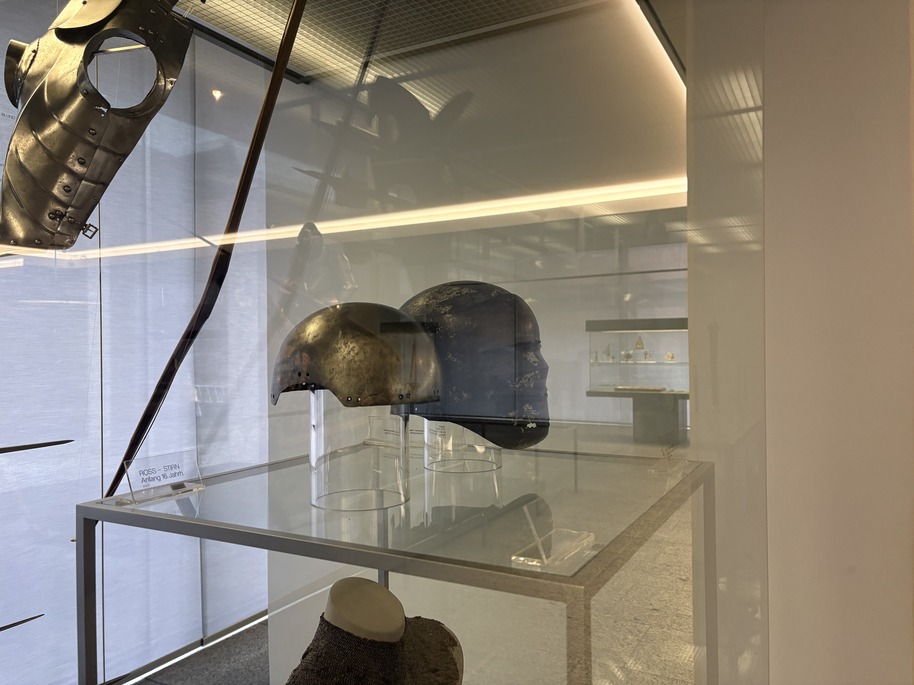
I’ve also noticed, to my amusement, that certain German secret (“secrete”) helms on display at the Germanisches Nationalmuseum in Nuremberg very closely resemble our own Novasteel helmet shell. Apart from differences in the type and thickness of the liner, they look like the same helmet.
Further inspection along such lines has uncovered many other similarities through the ages. This calls for a typological system which makes cross-temporal and cross-cultural comparisons legible – allowing, for instance, the morphological kinship between Sumerian helmets and medieval bascinets to be expressed in a common notation.
Like certain sword typologies, which separate blade form from pommel and guard types, this system treats shell form, face protection, neck defense, and other subsystems as independent variables that combine differently across periods and regions. Ultimately, it can be used to describe all combat helmets – over a period of more than 5000 years, stretching from at least 3000 B.C. to 2025 A.D. and beyond – by morphology and construction rather than by assumed date, place, or cultural origin.
One thing I would note in advance, which will be covered at length in the book but needs some justification here, is that helmets designed primarily to defend against melee weapons and arrows tend to have much more variance in their crown shapes. Pointed, peaked, and combed helmets were common centuries ago, though they seem strange to modern eyes as there are no modern helmets with similar forms. The Styrian Armory at Graz contains hundreds of conoidal and combed helmets, which are, from a modern perspective, much taller and heavier than they “need to be.” Suffice to say that such angled geometries make helmets considerably more effective against downward blows from sabres, maces, and arrows falling from the sky.
The typology is here in PDF format as a preprint: https://zenodo.org/records/17986416
Cite as: Ganor, J. (2025). Proposal for a Universal Combat Helmet Typology. Zenodo. https://doi.org/10.5281/zenodo.17986416
The whole thing is also below. A pictorial representation will be the subject of a future post.
Notation Format
A helmet is described as:
Sx–Ax–Fx–Bx–Nx–Mx-Cx–Lx–Rx
S = Shell crown form (primary shape) · A = Aural cut · F = Face system · B = Brim system · N = Neck system · M = Material · C = Construction · L = Liner/suspension · R = Retention
For unknown or indeterminate fields, use U in that field (SU, CU, etc.).
Where a field is absent, and evidence indicates absence, write 0. (e.g., F0 when a helmet does not incorporate a face protection system.)
S may take suffix modifiers; M/C may take lettered subtypes; F may take subtype plus optional aperture annotation; “?” may suffix any field to mark inference.
S-Series: Shell Crown Form
S encodes the shell’s core cranial form plus optional integral modifiers. Append t to indicate an integral rear tail formed continuously with the skull. Append n to indicate an integral nape flange. If the rear protection is attached as a separate component, do not use t or n; encode it in N-series (e.g., N1/N2/N3/N4). For enclosing shells (S6), append f (flat top), d (domed), or p (peaked) to record roof profile (e.g., S6f).
When more than one S-type seems to fit, use these precedence rules: S6 overrides all. Then S4 if elongation exceeds threshold. Then S3 if the side profile is predominantly conical. Then S5 for tall crowns that are not S3 or S4. Otherwise choose between S1 and S2 by rim drop.
Border cases (rim drop 40-60mm): Choose S2 if rim approaches ear height or wraps the occiput; otherwise S1; append ‘?’ if uncertain.
SU — Unknown / Too Fragmentary
Insufficient surviving material to classify shell form.
S1 — Shallow Cap
Low dome with rim typically at or above the upper-temple region. No integral rear tail; minimal side coverage from the shell itself. Diagnostic: Rim drop <40mm below crown apex at sides.
S2 — Deep Bowl
Dome or bowl with notably deeper drop at sides and/or back than S1. Shell provides “wrapped” cranial coverage with rim sitting low around the head. Diagnostic: Rim drop >60mm below crown apex, approaching or covering the ears.
S3 — Cone
Sides rise in a largely conical profile to an apex. A point, knob, or finial may exist but is not required. Diagnostic: Profile angle from rim to apex <60° from vertical.
S4 — Ovoid / Almond
Shell elongated fore–aft in plan view (egg or almond shape). Often features a medial keel or ridge, though this is not required. Diagnostic: Fore-aft dimension >1.15× lateral dimension at widest point.
S5 — High Crown
Tall shell with pronounced verticality – more “tower-like” than S2 – regardless of whether the apex is rounded or pointed. Diagnostic: Crown height >1.3× maximum shell width.
S6 — Enclosing Shell
Shell conceived as a full head enclosure rather than a cap or bowl: box, cylinder, or close-fitting container with small apertures. The enclosing geometry is primary rather than achieved through added face/neck components. Append f (flat top), d (domed), or p (peaked) to record roof profile. For e.g., a “sugar loaf” greathelm is S6p.
Note: A “kettle-hat” is typically S2 + brim type (B3/B4), not a unique shell class. A “sallet” is often S2t (if the tail is integral) plus appropriate face/visor codes.
A-Series: Aural cut
A encodes the shell’s aural cut: How the helmet rim is shaped around the ear region, independent of face hardware (F-series) and independent of brim geometry (B-series). Use A to describe whether the shell opening leaves the ears exposed, partially exposed, or covered by the shell’s rim line as worn in standard orientation.
A does not describe separate cheekpieces, ear lappets, or masks (encode those in F-series), and it does not describe brim projection that happens to shade the ears (encode in B-series). A describes the cut of the shell itself.
For unknown or indeterminate aural cut, use AU. If the shell has no meaningful ear region due to full enclosure (e.g., greathelms), A should be recorded as A0 (not applicable).
AU — Unknown/Indeterminate
Insufficient evidence to determine how the rim is cut around the ears (fragmentary rim, unclear orientation, missing side profile).
A0 — None / Not Applicable
Aural cut is not meaningfully defined because the shell is conceived as an enclosure rather than an open-rim helmet (typical of S6).
A1 — Ear-Covering Cut
The shell rim drops low enough at the ear station that the ear is covered by the shell opening as worn, or would be covered absent separate face components. Diagnostic: rim line at the ear station at or below the ear’s lower half on a headform (often near or below the tragus level). Common on full-coverage ballistic shells and many deep historical bowls.
A2 — Partial Ear Exposure
The rim line intersects the ear station such that the ear is partially exposed (upper or lower portion exposed) in the shell opening. This is the transitional state between full coverage and high-cut shells. Diagnostic: rim line passes through the ear region—neither clearly above the ear (A3) nor clearly below it (A1). Use ? if uncertain due to fit/orientation.
A3 — High-Cut / Ear-Exposed
The shell rim is cut high around the ear station, leaving the ear largely exposed in the opening as worn. Diagnostic: rim line lies clearly above the ear’s upper half (often above the helix/upper ear line on a headform).
F-Series: Face System
Rigid facial protection elements and their configuration. Cheekpiece subtypes (F2a–F2c) distinguish functionally and constructionally different approaches to lateral face protection.
Compound encoding (e.g., F2c+F3) is possible, see, e.g., the Sutton-Hoo helmet.
F0 — Open
No rigid facial defense beyond rim or brow reinforcement. Face fully exposed.
F1 — Nasal / Midline Bar
A rigid midline nasal bar or equivalent central guard is the primary facial element. May be fixed or adjustable.
F2 — Cheek/Ear Defenses
Rigid cheekpieces, ear covers, or lappets provide meaningful lateral facial protection while the face remains largely open frontally. Subtypes:
F2a — Integral cheekpieces: Cheek guards formed as part of the shell or rigidly fixed to it (e.g. Illyrian).
F2b — Hinged cheekpieces: Cheek guards attached via hinges allowing independent movement (e.g., Chalcidian, Roman cavalry).
F2c — Attached lappets: Separate cheek/ear defenses attached to rim or band, typically of different construction than the shell (e.g., Spangenhelm cheek guards, lamellar lappets).
F3 — Mask / Faceplate
A rigid, non-openable faceplate or mask provides primary frontal closure, with shaped apertures (cruciform, T-slit, ocular holes, breathing slots). Aperture geometry may be noted parenthetically after the subtype (e.g., F3a(+) cruciform, F3a(T) T-slit, F3a(O) ocular, F3b(f) frogmouth or horizontal slot, F3b(I) large opening with vertical bars). Subtypes:
F3a — Integral/permanent mask: Faceplate is formed as part of the shell or fixed in place as a non-removable component.
F3b — Detachable mask: Mask is a removable element (pins, hooks, straps), typically non-hinged; access/ventilation is achieved by removing the mask rather than lifting a visor.
F4 — Movable Visor Only
A hinged or pivoting visor (single principal movable element) provides frontal closure. The visor may lift, pivot laterally, or detach.
F5 — Visor + Lower-Face Closure
Visor combined with bevor, chin-piece, or equivalent lower-face defense. Together these elements close the face when in the “armed” configuration.
F6 — Fully Enclosing, Non-Openable
Face closure is integral and fixed, not an openable visor. Entry/exit is achieved by donning/doffing the entire helmet. (Note: This generally pairs with S6, but can apply even when the shell is not S6, thereby capturing certain masks/closures on otherwise non-enclosing shells.)
F7 — Lower-Face Guard / Mandible
A rigid lower-face element (bevor, chin-guard, mandible) provides meaningful jaw/chin protection while the upper face remains open and there is no movable visor as the primary closure. Subtypes:
F7a — Fixed: Lower-face element is integral to the shell or permanently fixed to it.
F7b — Detachable: Lower-face element is a removable accessory fitted as needed.
B-Series: Brim System
Perimeter projections beyond the vertical projection of the shell wall. A “brim” must project meaningfully (>15mm) to qualify; minor rim flanging is not a brim. For rear-only projections primarily protecting the nape, use N-series rather than B-series.
B0 — None
No brim or peak. Shell terminates at rim without significant horizontal projection.
B1 — Peak Only
Localized projection at brow/front; not circumferential. Provides shade and limited frontal rain/blow deflection.
B2 — Partial Brim
Distinct brim covering a sector (typically front and/or sides) but not full 360°. Rear-only projections that primarily protect the nape should be classified in the N-series (N1/N2). Subtypes:
B2a — Partial Brim, Planar: Brim sector largely in a single plane (within ±15° of horizontal over the brim area).
B2b — Partial Brim, Turned: Brim sector deliberately upturned/downturned (angle >25° from horizontal on ≥50% of the brim area).
B3 — Full Brim, Planar
360° brim largely in a single plane. May be slightly waved but not deliberately turned as a defining trait. Diagnostic: brim angle within ±15° of horizontal around full circumference.
B4 — Full Brim, Turned
360° brim with strong upturn or downturn as defining geometry. Diagnostic: brim angle >25° from horizontal on at least 50% of circumference.
B5 — Visor-Brim Hybrid
The “brim” function is achieved primarily by a projecting visor or peak integrated with the face system rather than a true circumferential brim.
N-Series: Neck System
Neck and nape protection elements. This series encodes protection that is attached to the helmet as a distinct component, versus integral shell geometry (which belongs in S-series).
N0 — None / Minimal Nape Drop
No distinct neck defense beyond the shell rim itself.
N1 — Attached Rigid Nape Flange
Small rigid rear flange projecting from shell rim (including rear-only brim-like projections). Non-integral – clearly a separate attached flange. For integral nape flanges, use the “n” modifier to S.
N2 — Attached Rigid Tail
Long rigid rear tail providing major nape/upper-neck coverage, attached as a separate rigid component (riveted plate, bolted extension) rather than formed as part of the shell geometry. Distinguished from S6 by construction: S6 tails are continuous with the shell; N2 tails are visibly joined.
N3 — Attached Flexible Curtain
Mail, leather, lamellar, scale, or textile defense hanging from rim or attachment band. Archaeological evidence includes regularly distributed rivet holes around helmet rims consistent with attaching organic or mail components.
N4 — Articulated Neck Defense
Lames or plates articulated to allow movement, attached to the helmet as a unit. Distinct from both a solid shell tail (t-modified S or N2) and a flexible curtain (N3).
N5 — Integrated Gorget Interface
Helmet designed to mate mechanically with a gorget or upper collar defense. The boundary between “helmet” and “gorget” is intentionally engineered as a system interface (flanges, slots, overlapping geometry).
M-Series: Material
The primary structural material of the protective shell. This series enables tracking technological evolution independently of form.
MU — Unknown
Material cannot be determined from available evidence.
M1 — Copper Alloy (Bronze, Brass)
Shell formed from copper-based alloys. Includes arsenical bronze, tin bronze, and brass.
M2 — Ferrous (Iron, Steel)
Shell formed from iron or steel. Includes wrought iron, low-carbon steel, and hardened/tempered steel.
M3 — Organic (Leather, Rawhide, Wicker)
Shell formed primarily from organic materials. Includes boiled leather (cuir bouilli), rawhide, lacquered leather, and woven plant fiber constructions.
M4 — Composite Traditional
Shell combining multiple traditional materials as structural and protective elements: metal or stone plates on leather substrate, horn and metal laminations, the boar-tusk helmets of Mycenae and the Iliad, etc.
M5 — Ballistic Composite
Modern fiber-reinforced composite shell: aramid (Kevlar), UHMWPE (Dyneema/Spectra), E-glass, or similar ballistic textiles in resin matrix.
M5a — Ceramic surface: Ballistic composite with ceramic strike face (alumina, silicon carbide, boron carbide) affixed to fiber backing.
M6 — Bulk Polymeric
Bulk polymers such as polycarbonate, PEEK, PEI, or similar, with or without short fiber or particle reinforcement.
M7 — Exotic Structural Metals
Titanium, aluminum, nickel, magnesium, zirconium, molybdenum, and alloys of those metals. High-entropy metals. Amorphous metals.
M8 — Precious Metals
Gold, silver, electrum, and other typically decorative or ceremonial precious metals.
C-Series: Construction
How the shell is made—fabrication method independent of material (M-series) or form (S-series).
CU — Unknown
Construction method cannot be determined.
C1 — One-Piece Monocoque Shell
Raised, forged, spun, or pressed as one rigid shell from sheet or billet. Includes traditional bronze raising and medieval steel skull forging.
C2 — Molded Shell
Shell formed in a negative mold with fluid/semi-fluid state or deposition.
C2a — Cast metal shell: Shell constructed via metal casting. Cast metallic shells may be finished by hammering, chasing, grinding, or polishing, but the basic form derives from a mold.
C2b — Molded polymer shell: Shell constructed via polymer casting, injection molding, thermoforming, vacuum forming, and other polymer forming methods.
C3 — Segmented Shell with Bands (Spangenhelm)
Plates riveted under or within crossing bands or a framework. The bands are structural, defining the geometry and holding plates in position.
C4 — Multi-Plate Riveted Shell
Large plates riveted edge-to-edge or overlapped to form the shell without a dominating band framework. Includes ridge-helm and “secret” constructions.
C5 — Scale/Lamellar on Substrate
Many small elements (scales, lamellar plates, rings) attached to or laced over an organic substrate that provides the shell form.
C6 — Pressed and Molded Composite Shell
Fiber/resin composite shell formed as a structural ballistic element: Aramid or UHMWPE fabric layers consolidated under heat and pressure. The composite layup is the shell structure.
C7 — Two-Shell System
Outer protective shell plus a separate rigid inner liner shell that carries suspension and fit. The U.S. “M1” helmet family exemplifies this: Steel outer shell, hard-hat-like inner liner with adjustable webbing. For C7 helmets, S/M/F/B/N/C describe the primary outer shell; L and R describe the helmet system as worn (often implemented on the inner liner shell).
L-Series: Liner / Suspension
How the head is supported inside the shell. Critical for comfort, stability, and impact protection.
LU — Unknown
No liner evidence survives or can be inferred.
L0 — None Present
No liner evidently used; the shell is designed to rest directly against the wearer’s head. Use L0 only when there is positive evidence of direct-contact intent (specification, preserved context, unambiguous sizing cues, or an interior edge treatment clearly meant for contact); otherwise use LU or L2
L1 — Attached Padding
Padding fixed to the helmet interior by stitching, rivets, or adhesive. Archaeological evidence includes rivet-hole patterns around rims consistent with attaching organic padding. The padding directly contacts the head without a suspension gap.
L2 — Separate Cap/Coif Worn Under
A separate organic cap, arming cap, or padded coif worn beneath the helmet provides fit and cushioning. Not fixed to the shell. Common where surviving helmets lack interior attachment points.
L3 — Internal Leather Band System
Internal leathers riveted to shell; linings sewn to those leathers and replaceable. This system allows liner replacement using the same attachment holes. Well-documented in late medieval armour construction.
L4 — Webbing/Basket Suspension
Webbing harness attached at multiple points forming a “basket” that suspends the head with a standoff gap from the shell. PASGT-style systems maintain approximately 12–13mm spacing for ventilation, impact deformation clearance, and blunt trauma protection.
L5 — Pad-Based Energy-Absorbing Liner
Foam or energy-absorbing pads arranged inside the shell, typically attached via Velcro or similar. Pads attenuate blunt impact and provide standoff. Standard in ACH and subsequent helmet generations.
L6 — Rigid Liner Shell with Suspension
A distinct rigid inner liner carries suspension geometry and fit bands. The liner provides uniform spacing between the outer shell and the head, distributing force via headband and nape band. Pairs with C7 (two-shell system).
R-Series: Retention
How the helmet is secured to the head. Retention evidence rarely survives in archaeological contexts, but attachment points often indicate system type. Note: If there is evidence of sewing points, lacing, or fixture geometry for integration, use R6; if there is evidence pointing to no retention and no integration mechanism, use R0; if neither can be determined, use RU.
RU — Unknown
No retention evidence survives; cannot determine whether a system existed.
R0 — Absent
Positive evidence indicates that no retention system was used, and it is not evident how the helmet is designed to be integrated into other headgear.
R1 — Simple Chin Tie/Thong
Two attachment points with a simple tie (cord, leather thong). Common where organic straps have not survived; inferred from paired attachment holes.
R2 — Chin Strap, Two-Point Adjustable
Two-point strap with buckle, hook, or other adjustment hardware. Standard through most historical periods where hardware survives.
R3 — Three-Point Harness
Harness with three independent attachment points (e.g., two lateral + one rear/nape, or a Y-type split). Seen in some industrial/work-at-height helmets and certain retrofit strap kits; uncommon in most archaeological contexts.
R4 — Four-Point Harness
Four-point retention creating a stable helmet-head interface. Standard in modern combat helmets (ACH, ECH, IHPS).
R5 — Boltless Retention
Retention system attached to helmet shell via Velcro or adhesive resin without slots or perforations in the helmet shell, uncommon.
R6 — Integrated into Secondary Headgear
No traditional harness. Sewn or laced into hat/hood.
Optional Fields
There are morphological variables that are of lower importance but can be described in the typology on an as-needed basis. Omit when not needed or not recorded.
Edge treatment and reinforcement can be described in an optional E series.
E0 none
E1 rolled/wired rim
E2 applied brow band
E3 reinforcing ribs/combs
This would allow the expression of crests or certain ridge-helm features without contorting S or C, but is rare and niche enough that it should remain optional, and used only when called for.
Practical Identification Key
- Work through the following sequence to classify an unknown helmet. Some steps may require physical examination or detailed photography.
- Shell form (S): Determine overall cranial geometry from silhouette and planform. Shallow cap (S1), deep bowl (S2), cone (S3), ovoid/almond (S4), high crown (S5), or enclosing shell (S6)? Apply precedence rules where multiple S-types seem to fit.
- Aural cut (A): Determine how the shell rim is cut around the ears, independent of cheekpieces/lappets (F-series) and independent of brim projection (B-series). Classify in standard orientation (brow forward, seated naturally). Ear-covering cut (A1), partial ear exposure (A2), high-cut / ear-exposed (A3), unknown (AU). If the helmet is an enclosing shell where an “ear opening” is not meaningfully defined, record A0 (not applicable).
- Face system (F): Identify rigid facial defense configuration. Movable visor only (F4) or visor plus lower-face closure (F5)? Fixed mask/faceplate (F3a) or detachable mask (F3b), with aperture annotation as applicable (e.g., (T), (+), (O), (f))? Fully enclosing, non-openable facial closure (F6)? Lower-face guard only (F7a/b)? Nasal bar (F1)? Cheekpieces/lappets (F2a/b/c)? Or fully open (F0)? Use compound encoding (e.g., F2c+F3) when two independent rigid subsystems are present.
- Brim system (B): Determine perimeter projection beyond the vertical projection of the shell wall. No brim (B0), peak only (B1), partial brim planar (B2a) or turned (B2b), full brim planar (B3) or turned (B4), or visor-brim hybrid (B5). Treat minor rim flanging as B0 unless projection exceeds the brim threshold.
- Neck system (N): Determine distinct nape/neck protection elements that are attached as separate components rather than integral to the shell. None/minimal (N0), attached rigid nape flange (N1), attached rigid tail (N2), attached flexible curtain (N3), articulated neck defense (N4), or integrated gorget interface (N5). If rear protection is integral to the shell, encode it in S using the appropriate integral modifier rather than in N.
- Material (M): Identify primary shell material. Copper alloy (M1), ferrous (M2), organic (M3), traditional composite (M4), ballistic composite (M5), ceramic-faced ballistic composite (M5a), bulk polymeric (M6), exotic structural metals (M7), precious metals (M8), or unknown (MU).
- Construction (C): Examine seams, rivets, bands, and surface evidence to determine fabrication method. One-piece monocoque (C1), molded (C2, with C2a cast metal or C2b molded polymer), segmented with bands / spangenhelm (C3), multi-plate riveted shell (C4), scale/lamellar on substrate (C5), pressed/molded composite shell (C6), or two-shell system (C7). Use CU if construction cannot be determined.
- Liner / suspension (L): Examine interior evidence for how the head is supported. None present with positive evidence (L0), attached padding (L1), separate cap/coif worn under (L2), internal leather band system (L3), webbing/basket suspension (L4), pad-based energy-absorbing liner (L5), or rigid liner shell with suspension (L6). Use LU if liner cannot be determined.
- Retention (R): Examine attachment points, slots, and fixtures for how the helmet is secured or integrated. Simple chin tie/thong (R1), two-point adjustable chin strap (R2), three-point harness (R3), four-point harness (R4), boltless retention (R5), integrated into secondary headgear (R6), absent with positive evidence (R0), or unknown (RU). Mark inferred identifications with “?” (e.g., R2?) rather than treating inference as direct evidence.
Appendix: Proposed Metrics
To make boundaries between types reproducible rather than judgment calls, the following measurements are proposed. All measurements should be taken from the helmet in standard orientation (brow forward, shell resting naturally). Thresholds are provisional and should be normalized to shell size (dimensionless ratios) where possible; absolute millimeter cutoffs are here utilized as heuristics.
Shell Form Metrics
- Rim drop: Vertical distance from crown apex to rim at the lateral midpoint (ear position). S1 <40mm, S2 >60mm.
- Profile angle: Angle of shell wall from vertical, measured at lateral midpoint. S3 (cone) <60° from vertical.
- Elongation ratio: Fore–aft dimension ÷ lateral dimension at widest. S4 (ovoid) >1.15.
- Crown height ratio: Crown height ÷ maximum shell width. S5 (high crown) >1.3.
- Tail length: For t-modified S, measured from rear rim of “bowl” portion to tail terminus. Minimum 50mm to qualify for the t suffix; otherwise classify as S2n.
Brim Metrics
- Brim projection: Horizontal distance from shell wall to brim edge. Minimum 15mm to qualify as brim (vs. rim flange).
- Brim angle: Angle from horizontal plane. Planar types (B2a/B3) within ±15°; turned types (B2b/B4) >25° on ≥50% of brim area/circumference.
Liner Metrics
- Attachment point count: Number and distribution of rim rivet holes. Regular distribution (4+ points, roughly symmetric) suggests L1 attached padding.
- Standoff gap: For suspension systems (L4, L5, L6), measured distance between shell interior and head contact surface. Modern ballistic helmets typically 10–15mm.
Design Principles
This typology follows several principles that distinguish it from period- or culture-bound classification systems:
- Morphology over origin: Classification is based on observable physical form and construction, not assumed date, place, or cultural affiliation. A Sumerian helmet and a medieval sallet can share a code if they share a form.
- Independent subsystems: Shell form, face protection, neck defense, construction method, liner, and retention are treated as independent variables. This reflects reality: the same shell form can appear with different face systems across periods.
- Archaeological compatibility: The system handles incomplete evidence. Unknown fields are marked “U” rather than forcing assumptions. The distinction between L1 (attached padding) and L2 (separate cap) is explicitly supported by archaeological analysis of rivet-hole patterns. Some fields may be inferred; inference is marked with a question mark – e.g. L3? or R2? – and never treated as evidentially equivalent to direct observation.
- Extensibility: New types can be added to any series without breaking existing classifications. If a shell form emerges that doesn’t fit S1-S6 – say, for instance, a diving-bell-style combat helmet – add S7. The notation remains consistent.
- Cross-temporal legibility: The system makes convergent evolution visible. A WWI Brodie and a medieval kettle hat both classify as S2–F0–B3, which makes clear the morphological kinship. Note that shared codes imply form similarity only; they do not assert cultural transmission.
Worked Examples
Ancient World (3000 BC – 500 AD)
1. Royal Cemetery of Ur Gold Helmet (c. 2500 BC)
Deep bowl form covering ears and nape, with integral tail-swept rear extension. Beaten gold sheet. Open face. No brim. One-piece construction. Liner and retention unknown (precious metal, burial context).
S2t–A1–F0–B0–N0–M8–C1–LU–RU
2. Early European Bronze Cap Helmet (Bronze Age)
Shallow cap or conical profile. Copper alloy, raised. Open face. No brim. Rivet holes around rim indicate attached padding. Paired holes suggest simple chin tie. Ears exposed by shell cut.
S1–A3–F0–B0–N0–M1–C1–L1–R1
Note: Use S3 if profile is distinctly conical.
3. Corinthian Helmet (c. 700–300 BC)
Deep bowl with integral, non-openable faceplate featuring eye and mouth apertures. Bronze. Ears fully covered by shell. No brim. Nape coverage integral. One-piece raised. Worn over padded cap.
S2–A1–F3a(O)–B0–N0–M1–C1–L2–R1
4. Illyrian Helmet (7th–4th c. BC)
Deep bowl with integral cheekpieces formed as part of the shell. Bronze. Ears covered. Open face above cheekpieces. No brim. One-piece raised.
S2–A1–F2a–B0–N0–M1–C1–L2–R1
5. Chalcidian Helmet (5th–4th c. BC)
Deep bowl with hinged cheekpieces allowing independent movement. Bronze. Ears covered by shell rim. Often has a nasal guard. No brim. One-piece raised.
S2–A1–F2b–B0–N0–M1–C1–L2–R1
Note: Add +F1 if nasal bar present.
6. Boar-Tusk Helmet (Mycenaean, c. 1600–1100 BC)
Cap form constructed from boar tusks sewn or laced to an organic substrate. Open face. Ears likely exposed. No brim. Composite traditional construction.
S1–A3–F0–B0–N0–M4–C5–L2–R1
7. Late Roman Ridge Helmet (4th–6th c. AD)
Deep bowl with medial ridge. Iron. Hinged cheekpieces. Ears covered. No brim. Mail curtain at rear. Multi-plate riveted construction along ridge. Leather band liner. Chin strap.
S2–A1–F2b–B0–N3–M2–C4–L3–R2
8. Roman Imperial Legionary Helmet (1st–3rd c. AD)
Deep bowl. Iron or bronze. Hinged cheekpieces. Ear-covering cut. No brim. Attached rear nape flange. Multi-plate or one-piece construction varies by type. Internal leathers. Chin strap.
S2–A1–F2b–B0–N1–M2–C4–L3–R2
Note: Some examples are C1 with applied details.
9. Roman Cavalry Parade Helmet with Detachable Mask (1st–2nd c. AD)
Iron helmet fitted with a removable full-face mask for parade or sport. Mask attaches by hooks/pins rather than hinged visor. Ears covered. No brim. Multi-plate construction. Leather band liner. Chin strap.
S2–A1–F3b(O)–B0–N0–M2–C4–L3–R2
10. Assyrian Conical Helmet (9th–7th c. BC)
Conical shell rising to a pointed apex. Iron or bronze. Open face. Ears exposed. No brim. No neck defense (worn over scale or lamellar). One-piece raised or multi-plate. Padded cap worn under.
S3–A3–F0–B0–N0–M2–C1–L2–R1
Note: Depicted extensively in Assyrian palace reliefs.
11. Phrygian-Style Helmet (4th–2nd c. BC)
Distinctive forward-curving apex creating fore-aft elongation in profile. Bronze. Open face or with hinged cheekpieces. Ears typically covered. No brim. One-piece raised.
S4–A1–F0–B0–N0–M1–C1–L2–R1
Note: The forward-leaning peak creates the ovoid signature. Add F2b if cheekpieces present.
12. Thracian Helmet (5th–3rd c. BC)
Tall crown with pronounced peak, often forward-swept. Bronze. Integral cheekpieces or open. Ears covered. No brim. One-piece raised. Worn over cap.
S5–A1–F2a–B0–N0–M1–C1–L2–R1
Note: Some examples are distinctly ovoid (S4) rather than just tall (S5).
Migration Period & Early Medieval (500–1100 AD)
13. Migration Period Spangenhelm (5th–7th c. AD)
Deep bowl or slightly conical. Iron bands with bronze/iron plates. Attached cheek lappets of different construction than shell. Partial ear exposure at rim. No brim. Mail curtain common. Banded construction. Internal leathers probable.
S2–A2–F2c–B0–N3–M2–C3–L3–R2
Note: Many variants add nasal (F1) or change neck defense (N0/N3).
14. Sutton Hoo Helmet (7th c. AD)
Deep bowl. Iron with decorated bronze/silver panels. Attached lappets plus fixed faceplate with eyeholes and nose/mouth guard. Partial ear exposure. No brim. Mail curtain at rear. Multi-plate construction. Internal leathers.
S2–A2–F2c+F3a–B0–N3–M2–C4–L3–R2
Note: Compound face encoding captures both lappets and faceplate.
15. Vendel/Valsgärde Helmets (6th–8th c. AD)
Deep bowl, often with pronounced crest/comb. Iron. Spectacle-type eye guards or attached face elements. Partial ear exposure. No brim. Mail curtain. Multi-plate riveted. Internal leathers.
S2–A2–F2c+F3a–B0–N3–M2–C4–L3–R2
16. Norman Nasal Helm (11th c.)
Conical shell. Steel. Fixed nasal bar as primary face defense. Ears exposed by shell cut. No brim. No integral neck defense (worn over mail coif). One-piece forged. Arming cap worn under.
S3–A3–F1–B0–N0–M2–C1–L2–R1
Note: If helmet carries attached mail, add N3.
17. Cervellière / Skullcap (12th–14th c.)
Shallow cap or borderline deep bowl. Steel. Open face. Ears exposed. No brim. No neck defense. One-piece forged. Worn over mail coif or padded cap.
S1–A3–F0–B0–N0–M2–C1–L2–R1
Note: Deep skullcaps drift into S2.
High & Late Medieval (1100–1500 AD)
18. Great Helm, Flat-Topped (13th c.)
Enclosing cylindrical shell with flat top. Steel. Fixed faceplate with cruciform aperture. Aural cut not applicable (full enclosure). No brim. No attached neck defense (worn over mail). Multi-plate riveted. Internal leather bands. Simple chin tie.
S6f–A0–F3a(+)–B0–N0–M2–C4–L3–R1
19. Great Helm, Sugar Loaf (13th–14th c.)
Enclosing shell with peaked/conical top. Steel. Fixed faceplate with cruciform or T-slit aperture. Full enclosure. No brim. Multi-plate riveted. Internal leathers.
S6p–A0–F3a(+)–B0–N0–M2–C4–L3–R1
Note: Use F3a(T) for T-slit aperture.
20. Kettle Hat / Chapel-de-Fer (13th–15th c.)
Deep bowl. Steel. Open face. Shell rim sits high, leaving ears exposed (brim provides overhead cover but not aural coverage). Full planar brim. No neck defense. One-piece raised or multi-plate. Internal leathers. Chin strap.
S2–A3–F0–B3–N0–M2–C1–L3–R2
Note: If brim is distinctly up/downturned, use B4. If multi-plate skull, use C4.
21. Bascinet, Open (14th c.)
Deep bowl, often with slight fore-aft elongation. Steel. Open face. Ears covered. No brim. Mail aventail at rear. One-piece raised. Internal leathers.
S2–A1–F0–B0–N3–M2–C1–L3–R2
Note: Use S4 if elongation ratio exceeds threshold.
22. Bascinet, Visored / Klappvisor (14th–15th c.)
Deep bowl or ovoid. Steel. Movable visor (klappvisor or hounskull). Ears covered. Visor provides peak function. Mail aventail. One-piece raised. Internal leathers. Chin strap.
S2–A1–F4–B5–N3–M2–C1–L3–R2
Note: Use S4 if distinctly ovoid. Use B0 if visor does not project meaningfully.
23. Pig-Faced Bascinet / Hounskull (late 14th–15th c.)
Ovoid shell with pronounced fore-aft elongation. Steel. Long pointed visor (“pig face” or “dog face”) creates distinctive snout. Ears covered. Visor projects forward. Mail aventail. One-piece raised skull. Internal leathers.
S4–A1–F4–B5–N3–M2–C1–L3–R2
Note: The elongated skull + projecting visor define this as S4. Classic example of ovoid shell form.
24. Tall Bascinet / Grand Bascinet (15th c.)
High-crowned shell with pronounced verticality. Steel. Full visor + bevor or wrapper closing face. Ears covered. Mail aventail or plate gorget interface. One-piece raised. Internal leathers.
S5–A1–F5–B0–N3–M2–C1–L3–R2
Note: Distinguished from standard bascinet by crown height ratio >1.3×.
25. Barbute (15th c.)
Deep bowl, often ovoid with pronounced T-shaped or Y-shaped facial opening. Steel. The opening constitutes a fixed mask geometry. Ears covered. No brim. No attached neck defense. One-piece raised. Internal leathers.
S2–A1–F3a(T)–B0–N0–M2–C1–L3–R2
Note: Use S4 if distinctly ovoid.
26. German Sallet, Visored (c. 1450–1490)
Tail-swept shell with integral long rear extension. Steel. Movable visor. Partial ear exposure for hearing. Visor provides peak function. Integral tail. One-piece raised. Internal leathers with replaceable liner. Chin strap.
S2t–A2–F4–B5–N0–M2–C1–L3–R2
27. German Sallet, Open (c. 1450–1490)
Tail-swept shell with integral rear extension. Steel. Open face. Partial ear exposure. No brim. Integral tail. One-piece raised. Internal leathers.
S2t–A2–F0–B0–N0–M2–C1–L3–R2
28. Italian Sallet with Bevor (15th c.)
Tail-swept shell. Steel. No visor; separate detachable bevor provides lower-face coverage. Partial ear exposure. No brim. Integral tail. One-piece raised. Internal leathers. Chin strap.
S2t–A2–F7b–B0–N0–M2–C1–L3–R2
29. Armet (15th c.)
High crown or deep bowl with full facial closure via visor + hinged cheek plates that meet at chin. Steel. Ears enclosed when armed. No brim. Gorget interface or articulated neck defense common. One-piece skull. Internal leathers.
S5–A1–F5–B0–N5–M2–C1–L3–R2
Note: The hinged cheek closures combine with visor for F5 classification.
Renaissance & Early Modern (1500–1700 AD)
30. Close Helm (16th c.)
High crown or deep bowl. Steel. Visor + bevor closing face completely. Ears covered when armed. No brim. Articulated neck lames or gorget interface. One-piece skull. Internal leathers.
S5–A1–F5–B0–N5–M2–C1–L3–R2
Note: Often the best exemplar of helmet+gorget interface (N5).
31. Burgonet (16th c.)
Deep bowl. Steel. Hinged cheekpieces; face otherwise open. Peak only at brow. Ear coverage by shell or cheekpieces. Small nape flange or none. One-piece skull. Internal leathers.
S2–A1–F2b–B1–N1–M2–C1–L3–R2
Note: Optional falling buffe changes face to F7b.
32. Morion (16th c.)
High crown with pronounced verticality. Steel. Open face. Ears covered. Full brim with strong upturn at front and rear (turned). No neck defense. One-piece raised. Internal leathers.
S5–A1–F0–B4–N0–M2–C1–L3–R2
Note: High crown + turned-up brim is the recognizable signature (S5+B4).
33. Combed Morion (16th c.)
Very tall crown with pronounced medial comb/ridge running fore-aft. Steel. Open face. Ears covered. Full brim with strong upturn. No neck defense. One-piece raised. Internal leathers.
S5–A1–F0–B4–N0–M2–C1–L3–R2
Note: Extreme example of S5; comb can be recorded via optional E3 (reinforcing ribs/combs).
34. Pikeman’s Pot (17th c.)
Tall conical or high-crowned shell. Steel. Open face. Ears covered or partially. Partial brim or peak only. No neck defense or small flange. One-piece or multi-plate. Internal leathers.
S5–A1–F0–B2a–N0–M2–C1–L3–R2
Note: English Civil War era. Some examples are S3 (conical) rather than S5 (high crown).
35. Cabasset (16th c.)
Conical or high crown shell. Steel. Open face. Ears covered. Full brim, planar or slightly turned. No neck defense. One-piece raised. Internal leathers.
S3–A1–F0–B3–N0–M2–C1–L3–R2
Note: Taller examples drift into S5; brim treatment varies by region (B3 vs B4).
36. Lobster-Tail Pot / Zischägge (17th c.)
Deep bowl. Steel. Hinged cheekpieces, often with nasal bar. Peak at brow. Articulated laminated neck defense (the “lobster tail”). Multi-plate construction. Internal leathers.
S2–A1–F2b+F1–B1–N4–M2–C4–L3–R2
Note: Defining feature is articulated neck defense (N4) + peak (B1).
37. German Secret Helmet / Secrete (16th–17th c.)
Thin steel skullcap concealed under a hat. Open face. Ears exposed. No brim. No neck defense. Often multi-plate riveted, some one-piece. Internal leather band. Typically integrated into hat (no traditional harness).
S1–A3–F0–B0–N0–M2–C4–L3–R6
Note: If truly one-piece, use C1.
Islamic & Eurasian Helmets
38. Mongol/Turko-Mongol Helmet (13th–15th c.)
Conical shell rising to pointed apex, often with spike or plume holder. Iron or steel. Open face or with nasal. Ears exposed or partial coverage. No brim. Mail or lamellar curtain at rear. Multi-plate or one-piece construction.
S3–A3–F0–B0–N3–M2–C4–L2–R1
Note: Add F1 if nasal bar present.
39. Ottoman Chichak / Sipahi Helmet (15th–17th c.)
Tall conical shell, often fluted or with medial ridge. Steel. Nasal bar with sliding adjustment. Partial ear coverage. No brim. Mail curtain. One-piece forged. Internal padding.
S3–A2–F1–B0–N3–M2–C1–L1–R2
40. Persian Kulah Khud (16th–19th c.)
Tall conical or ovoid shell with spike finial. Steel, often decorated. Nasal bar with sliding guard. Ears partially exposed. No brim. Mail curtain. One-piece forged.
S3–A2–F1–B0–N3–M2–C1–L1–R2
Note: Use S4 if shell shows pronounced fore-aft elongation; S5 if crown height exceeds threshold.
41. Russian Shishak (16th–17th c.)
Tall conical shell with pronounced spike. Steel. Open face or with nasal. Partial ear coverage. No brim. Mail curtain or articulated neck defense. One-piece forged.
S3–A2–F0–B0–N3–M2–C1–L1–R2
Note: Add F1 if nasal present. Some examples have N4 articulated defense.
42. Mamluk Helmet (14th–16th c.)
High crown with pronounced verticality, often with medial ridge. Steel. Open face or with nasal. Ear coverage varies. No brim. Mail curtain. One-piece forged.
S5–A2–F0–B0–N3–M2–C1–L1–R2
Note: The tall crown distinguishes from standard conical (S3).
43. Indo-Persian Helmet / Top (16th–19th c.)
Ovoid shell with distinct fore-aft elongation, often with medial rib. Steel. Nasal bar and/or face guard. Partial ear coverage. No brim. Mail curtain. One-piece forged or raised.
S4–A2–F1–B0–N3–M2–C1–L1–R2
Note: The fore-aft elongation (>1.15× ratio) defines S4 classification.
44. Mughal Helmet (16th–18th c.)
High-crowned shell, often bulbous or with pronounced dome. Steel, frequently gilt or decorated. Nasal guard. Partial ear coverage. No brim. Mail or plated curtain. One-piece forged.
S5–A2–F1–B0–N3–M2–C1–L1–R2
Note: Distinguished by tall crown (height >1.3× width).
Japanese Helmets
45. Kabuto, Suji-Bachi (Multi-Plate) (15th–17th c.)
High crown or conical shell constructed from many vertical plates. Iron/steel. Face often open or fitted with separate menpō (detachable face guard). Peak common. Ears partially exposed. Articulated neck defense (shikoro) standard. Multi-plate riveted. Worn over padded cap.
S5–A2–F0–B1–N4–M2–C4–L2–R1
Note: Add F7b if menpō present; F3b for full masks.
46. Kabuto, Zunari (Few-Plate Bowl) (16th–17th c.)
Deep bowl or high crown from fewer, larger plates. Iron/steel. Face typically open or with separate menpō. Peak or none. Partial ear exposure. Articulated shikoro. Multi-plate construction. Padded cap worn under.
S2–A2–F0–B1–N4–M2–C4–L2–R1
Note: Simpler plate architecture than suji-bachi but same subsystem logic.
47. Jingasa (Ashigaru Hat-Helmet)
Conical hat form. Iron, bronze, or lacquered organic materials. Open face. Ears exposed or partially covered depending on depth. Partial brim. No articulated neck defense. One-piece or molded construction. Worn over cap.
S3–A3–F0–B2a–N0–M2–C1–L2–R1
Note: Construction varies: C2a for cast, C2b for molded organic.
World War I Era
48. British Brodie / Mk I (1915+)
Deep bowl. Steel. Open face. Shell rim sits high, leaving ears exposed (brim provides overhead cover but not aural coverage). Full planar brim. No neck defense. One-piece pressed. Webbing suspension. Chin strap.
S2–A3–F0–B3–N0–M2–C1–L4–R2
Note: Morphologically a kettle hat with modern liner/retention. Brim does not count toward A-series.
49. French Adrian M15 (1915+)
Deep bowl. Steel. Open face. Shell rim sits high, leaving ears exposed. Peak/visor at front. Attached rigid rear nape plate. Multi-plate construction (riveted crest and components). Internal leather band system. Chin strap.
S2–A3–F0–B1–N2–M2–C4–L3–R2
50. German Stahlhelm M16/M17/M18 (1916+)
Deep bowl with pronounced temporal/nape flare designed for ear and temple protection. Steel. Open face. Ears covered or partially covered by shell rim. Peak at front. No attached neck defense. One-piece pressed. Internal leather band system. Chin strap.
S2–A1–F0–B1–N0–M2–C1–L3–R2
Note: Use A2 if fit leaves ears partially exposed. Deep integral coverage captured by S2 rim drop.
51. U.S. M1917 (1917+)
Deep bowl (Brodie-derived). Steel. Open face. Shell rim sits high, leaving ears exposed. Full planar brim. No neck defense. One-piece pressed. Webbing suspension. Chin strap.
S2–A3–F0–B3–N0–M2–C1–L4–R2
World War II Era
52. British Mk II (1938+)
Deep bowl. Steel. Open face. Shell rim sits high, leaving ears exposed (brim provides overhead cover but not aural coverage). Full planar brim. No neck defense. One-piece pressed. Webbing suspension. Chin strap.
S2–A3–F0–B3–N0–M2–C1–L4–R2
Note: Morphologically a kettle hat with modern liner/retention. Brim does not count toward A-series.
35. French Adrian M15 (1915+)
Deep bowl. Steel. Open face. Shell rim sits high, leaving ears exposed. Peak/visor at front. Attached rigid rear nape plate. Multi-plate construction (riveted crest and components). Internal leather band system. Chin strap.
S2–A3–F0–B1–N2–M2–C4–L3–R2
36. German Stahlhelm M16/M17/M18 (1916+)
Deep bowl with pronounced temporal/nape flare designed for ear and temple protection. Steel. Open face. Ears covered or partially covered by shell rim. Slight peaked brim. No attached neck defense. One-piece pressed. Internal leather band system. Chin strap.
S2–A1–F0–B1–N0–M2–C1–L3–R2
Note: Use A2 if fit leaves ears partially exposed. Deep integral coverage captured by S2 rim drop.
37. U.S. M1917 (1917+)
Deep bowl (Brodie-derived). Steel. Open face. Shell rim sits high, leaving ears exposed. Full planar brim. No neck defense. One-piece pressed. Webbing suspension. Chin strap.
S2–A3–F0–B3–N0–M2–C1–L4–R2
World War II Era
38. British Mk II (1938+)
Deep bowl. Steel. Open face. Shell rim sits high, leaving ears exposed. Full planar brim. No neck defense. One-piece pressed. Webbing suspension. Chin strap.
S2–A3–F0–B3–N0–M2–C1–L4–R2
Note: Same morphological signature as Brodie; changes are dimensional/liner refinements.
39. U.S. M1 Helmet (1941–1980s)
Deep bowl. Steel outer shell. Open face. Ears partially covered by shell rim. No brim. No neck defense. One-piece pressed outer + rigid liner shell carrying suspension. Two-shell system. Chin strap.
S2–A2–F0–B0–N0–M2–C7–L6–R2
40. Soviet SSh-40 (1940+)
Deep bowl with pronounced temporal coverage. Steel. Open face. Ears covered or partially covered by shell rim. No brim. No neck defense. One-piece pressed. Internal leather band system. Chin strap.
S2–A1–F0–B0–N0–M2–C1–L3–R2
Note: Use A2 if fit leaves ears partially exposed.
41. German Stahlhelm M35/M40/M42 (1935–1945)
Deep bowl with characteristic flared temporal coverage. Steel. Open face. Ears covered or partially covered. Slight peaked brim. No attached neck defense. One-piece pressed. Internal leather band system. Chin strap.
S2–A1–F0–B1–N0–M2–C1–L3–R2
Note: Refinement of WWI Stahlhelm; same typological signature. Use A2 if fit leaves ears partially exposed.
Modern Ballistic Helmets
42. PASGT Helmet (1983–2000s)
Deep bowl. Aramid composite. Open face. Ears covered by shell rim. Slight peaked brim. No neck defense. Molded composite shell. Webbing basket suspension (~12mm standoff). Four-point retention.
S2–A1–F0–B1–N0–M5–C6–L4–R4
43. ACH (Advanced Combat Helmet) (2002+)
Deep bowl. Aramid composite. Open face. Ears covered. No brim. No neck defense. Molded composite shell. Pad-based energy-absorbing liner. Four-point retention.
S2–A1–F0–B0–N0–M5–C6–L5–R4
44. ECH (Enhanced Combat Helmet) (2013+)
Deep bowl. UHMWPE composite. Open face. Ears covered. No brim. No neck defense. Molded composite shell. Pad-based liner. Four-point retention.
S2–A1–F0–B0–N0–M5–C6–L5–R4
45. Ops-Core FAST / High-Cut Helmets (modern)
Deep bowl with high-cut ear area for communications headsets. Ballistic composite. Open face. Ears exposed by shell cut. No brim. No neck defense. Molded composite shell. Pad-based liner. Four-point retention.
S2–A3–F0–B0–N0–M5–C6–L5–R4
Note: High-cut (A3) distinguishes from full-coverage shells (A1).
46. IHPS (Integrated Head Protection System) (2019+)
Deep bowl with modular appliqué options. UHMWPE composite. Open face in base configuration. Ear coverage depends on configuration. No brim. Modular mandible/visor options. Molded composite. Pad-based liner. Four-point retention.
S2–A1–F0–B0–N0–M5–C6–L5–R4
Note: Base configuration shown; add F7b if mandible fitted.
47. NovaSteel Helmet, Base Configuration (modern)
Deep bowl. Steel. Open face. Ears exposed by shell cut. No brim. No neck defense. One-piece pressed/formed shell. Pad-based energy-absorbing liner. Four-point retention.
S2–A3–F0–B0–N0–M2–C1–L5–R4
Note: Morphologically similar to 16th–17th c. secret helmets, with modern liner/retention.
48. NovaSteel Helmet with Fixed Mandible (modern)
Deep bowl. Steel. Rigid faceplate detachable by removing four bolts; horizontal slot aperture (frogmouth orientation). Ears covered. No brim. No neck defense. One-piece pressed shell. Pad-based liner. Four-point retention.
S2–A1–F3b(f)–B0–N0–M2–C1–L5–R4